LET'S CHAT.
Essential agreements provide the outline of how to navigate a space. They make us feel more secure in an uncertain, unpredictable world.
As a teacher, essential agreements are vital. They set the tone for how a classroom will look, sound, and feel. They guide behavior, cultivate community, and convey a sense of safety. To grow — to learn — is inherently vulnerable. It’s messy, uncomfortable, complex. Essential agreements provide consistency. They are the foundation needed for us to engage bravely. It is only then that we are able to unlock our creativity, connect with others, and expand our perspective.
However, Growing Pains isn’t a classroom. We aren’t bounded by time or place. Our engagement is largely without a face to see, a voice to hear — emotion to feel. Our humanity is reduced to words and images on a screen. So, how do we enter this intangible space? A space where humans exist but whose presence is often inaccessible? Where words and actions are easily misinterpreted? Where nothing feels quite like reality????
It’s strange to exist here. It takes courage to show up — to lean into discomfort. It’s intimidating to share among strangers and friends. Yet, it’s liberating too. Being vulnerable has allowed me to connect — to feel a sense of belonging. But, it doesn’t feel habitual. My norm isn’t transparency. It’s to hide — to isolate — to disassociate out of fear. Vulnerability is scary AND I can’t do it alone. I need your help to maintain a safe, yet brave space.
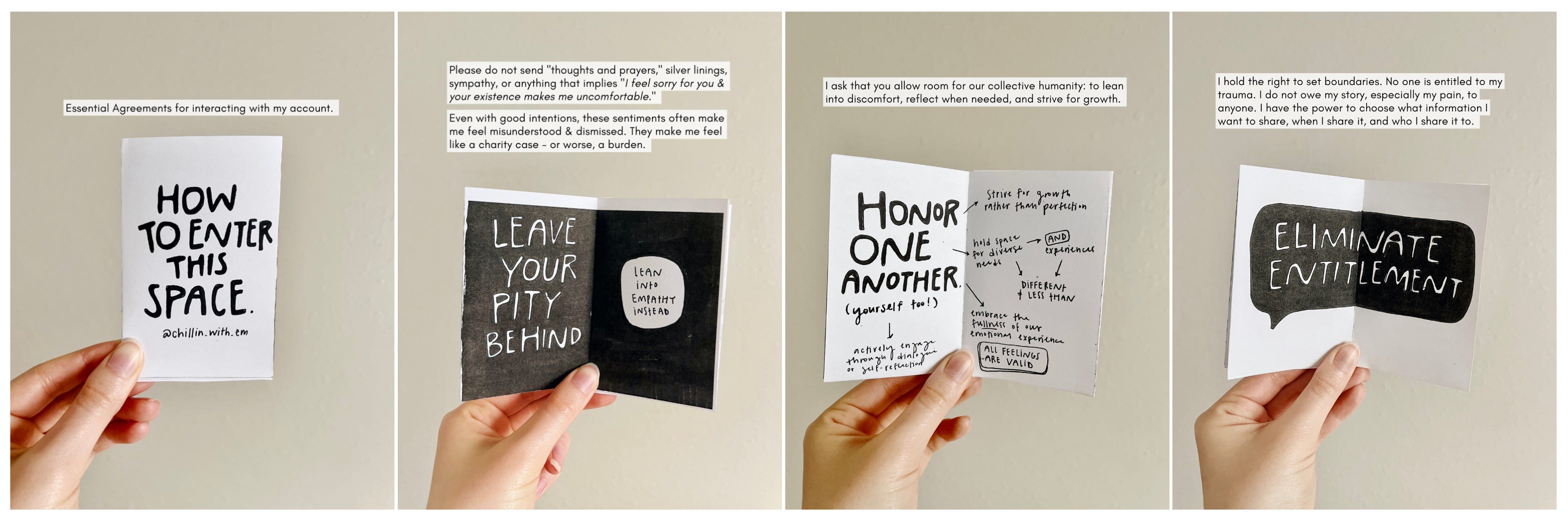
HERE ARE THE WAYS YOU CAN HELP:
Leave your pity behind. Lean into empathy instead. Please do not send "thoughts and prayers," silver linings, sympathy, or anything that implies "I feel sorry for you & your existence makes me uncomfortable.” Even with good intentions, these sentiments often make me feel misunderstood & dismissed. They make me feel like a charity case - or worse, a burden. Brené Brown beautifully describes the difference between sympathy and empathy in this video.
Honor one another (including yourself). Hold space for diverse needs and experiences. Acknowledge that different ≠ 'less than.' Actively engage through dialogue and self-reflection. Strive for growth rather than perfection, connection rather than isolation. Validate emotions as they arise.
Eliminate entitlement. Please know that I hold the right to set boundaries. My story (especially my pain) is not owed — it’s offered. As Brené Brown teaches, vulnerability is based on mutuality and trust. Therefore, I deserve the right to choose what information I want to share, when I share it, and who I share it to. I deserve that autonomy — as do you. Being curious is valid — even encouraged. However, we must be mindful of how we respond to it. We must honor one’s privacy in addition one’s openness. Pausing to reflect has helped me greatly. Through it, I’ve been able to determine why I want information and whether or not I need it. I’ve also been able to process the emotional weight of my question and whether or not I have an established relationship with the creator/writer. Over time, I’ve learned that strangers aren’t entitled to intimate details — my interest (or those of others) does not warrant a response. I do not have to please others at the cost of myself.
Boundary Statement: My thoughts on chronic illness, disability, and mental health are a synthesis of personal experience and expansion work. However, my knowledge and abilities are limited. I’m ill-equipped to support people on an individual basis. Please seek local and/or national resources for personalized care. To assist, I’ve compiled a list of therapy, peer mentorship and community care programs. You can find them under my mental health tab.